

How to Spot Fake Influencers Before You Spend Your Marketing Budget
A client came to us last year with a creator already picked out. 180K followers, great aesthetic, comments section full of hearts. We ran one check before signing anything, and the engagement rate came back under 0.2%. That account was padded with fake followers, and the campaign budget would’ve gone straight into a black hole.
This happens more than brands admit. Influencer fraud isn’t some fringe problem anymore; it’s routine enough that most marketers now name it as a top concern before greenlighting any influencer collaboration. And fake followers are only a part of it; you can actually see it on the surface.
The Follower Count Was Never the Real Problem
Brands obsess over follower numbers because they’re the easiest thing to screenshot and drop into a pitch deck. But a big number means nothing if the people behind it aren’t real, aren’t watching, and definitely aren’t buying. This is exactly why follower count on its own has stopped being a reliable metric for choosing influencers, no matter how big an agency or brand is.
Fake followers don’t click links. They don’t sit through a product video. They don’t ever walk into a store. So when a campaign built on a fat follower count underperforms, the usual response is to blame the creative or the offer, when the actual issue was that the audience receiving it barely existed in the first place.
That’s the quiet damage influencer fraud does to a marketing budget. It doesn’t just waste one campaign; it poisons the data you use to plan the next five. A brand ends up thinking a whole content format “doesn’t work” when, really, nobody ever really saw it. This is also where influencer marketing ROI takes the biggest, least visible hit, not in the invoice, but in every decision made using bad numbers afterwards.
Fraud Goes Way Past Follower Count
Bought followers are the most obvious version of influencer fraud, but far from the only one. Bots can be layered onto an otherwise real audience. Engagement pods, small groups of creators who quietly like and comment on each other’s posts, can inflate numbers without a single fake follower involved. Views get manipulated on Reels and Shorts. And more recently, fully AI-generated personas are being built specifically to pass as real creators.
A profile can look completely clean on a follower-count level and still be running fraud underneath it. That’s exactly why checking one number and calling it done is how most brands get burned, and why influencer vetting needs to look at engagement, growth pattern, and content history together, not any single metric in isolation.
What Actually Gives a Fake Influencer Away
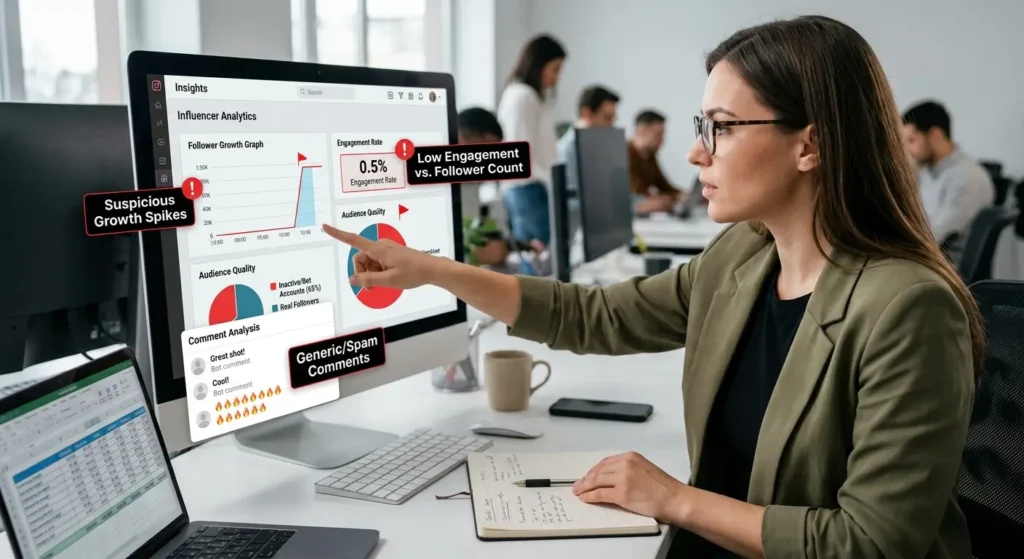
Engagement rate that doesn’t match the following. This is the fastest test there is, and it catches the most obvious fake influencers on its own. A creator with 150K followers pulling 200 likes per post is a red flag; no interpretation needed. Real accounts typically sit somewhere between 1% and 5% engagement, depending on the platform and niche, so anything far below that at scale is worth a second look before any contract gets signed.
Growth charts with a spike and then a flat line. Real audiences build slowly, over months, sometimes years, through actual content and word of mouth. A sudden jump followed by stagnant or declining growth almost always points to a bulk purchase of fake followers rather than organic reach.
Comments that could belong to any post. Real audiences leave messy, specific reactions tied to what’s actually in the content. Fake engagement repeats itself: generic praise, emoji strings, comments that would fit under literally any photo on the internet. If half the comment section reads like it was copy-pasted, it probably was.
Audience demographics that don’t add up. A skincare creator whose followers are supposedly Indian women in their twenties, but the real breakdown skews toward an unrelated country or age group entirely. That kind of mismatch is rarely accidental, and it’s one of the clearer signs of influencer fraud once you know to check for it.
A content library that feels stitched together. Mismatched styles, captions that read like they were written for a different person, sudden jumps in production quality with no real progression leading up to it. Rented-out fake influencer accounts often look exactly like this once you scroll back a few months.
Engagement pods disguised as organic reach. Harder to catch because the accounts involved are usually real people, not bots. The giveaway is the same small cluster of accounts showing up heavily on every single post, regardless of what’s actually being posted.
Checking for Fake Followers Yourself Takes Ten Minutes
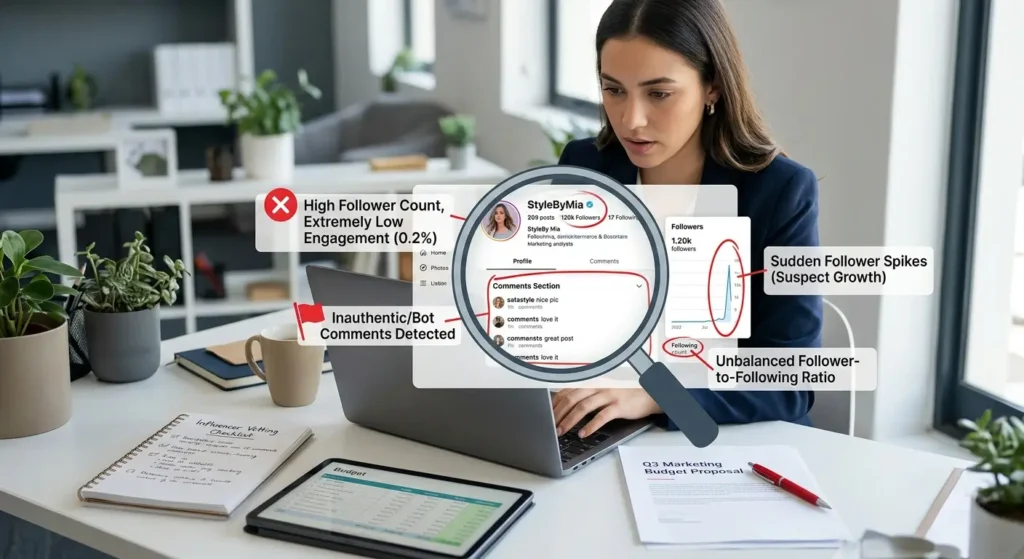
Open the profile. Look at average likes and comments against total followers to get a real sense of engagement rate. Glance at the growth chart for spikes. Read fifteen or twenty comments and see if they sound specific or interchangeable. If demographics are visible on the platform, check those too. If something still feels off, search a caption or two; copy-pasted captions showing up across unrelated accounts is a strong tell that a profile has been padded with fake followers.
None of this catches everything. Sophisticated influencer fraud today is built specifically to survive a casual scroll-through. But this kind of manual check filters out a large share of the obvious cases before any part of the marketing budget actually moves.
When a Paid Fraud Detection Tool Actually Earns Its Cost
For bigger budgets, macro-influencer deals, or campaigns running across several creators at once, manual checks stop being enough on their own. Fake follower checker tools built on machine learning can flag suspicious growth patterns, score audience quality, and estimate what percentage of a following is inactive or outright fake, at a scale no team has time to replicate by hand across dozens of creators.
This isn’t about assuming every influencer is scamming brands. Most creators build their following honestly, one real post and one real audience at a time. It’s about making sure the marketing budget actually reaches the ones who did, instead of getting quietly absorbed by influencer fraud somewhere along the way.
How 6th Street Artist Vets Influencers Before You Ever Pay
Every creator in our network gets checked for engagement authenticity, audience quality, and content consistency before they’re ever pitched to a client, not after a campaign quietly underperforms. As an influencer marketing agency working across Mumbai and Dubai, we treat this kind of vetting as a filter every profile has to pass, not an optional add-on service tacked onto a proposal.
That’s also why brands come back to run more campaigns with us. The influencers on the other end of a collaboration are real, their audiences are real, and the numbers we hand over at the end of a campaign actually mean something.
The Cost Nobody Puts in the Report
Wasted spending is the part everyone notices first. The part that goes unnoticed is the bad data that the campaign leaves behind, quietly shaping decisions for months afterward, plus the reputational risk of a brand getting publicly linked to a known influencer fraud case. Skipping this check costs a lot more than one bad invoice; it costs every campaign built on the false confidence that the invoice created.
Spotting fake influencers isn’t about distrusting every creator you meet. It’s a ten-minute habit, repeated before every collaboration, that makes sure the marketing budget lands on people who are actually real, actually watching, and actually worth the spend.
Want your next influencer campaign built on verified, fraud-checked talent? Call us at +91 91366 69815 or write to us at info@6thstreetartist.com
Follow us on Instagram, LinkedIn, and YouTube for more on influencer marketing, fake follower detection, and creator vetting.

Manpreet Singh Chadha was a visionary entrepreneur and co-founder of 6th Street Artist, a Mumbai-based influencer marketing agency. With a passion for empowering creators and brands, he played a pivotal role in shaping the agency’s mission to revolutionize influencer marketing in India. His legacy continues to inspire the industry.