
Paid Ads Getting Expensive? Here’s Why Brands Are Investing in Influencer Marketing
Spending more on ads that people skip is not a plan.
Ask any performance marketer what has changed in the last two years and you will hear the same thing. The money goes further. Costs are up. The same budget that used to bring in a solid number of leads is now delivering noticeably fewer. And the frustrating part is that nothing on your end changed. You are doing the same things. The platform just got more expensive.
This is happening across Meta, Google, YouTube, and every other major paid channel. And it is not going back to where it was. The brands that are growing despite this are not the ones spending more. They are the ones spending differently. A big part of that shift is influencer marketing, and at 6th Street Artist, we have watched it happen with enough brands now to say with confidence that it is not a trend. It is a structural change in how marketing budgets work.
Why Paid Ads Have Gotten So Expensive?
Everyone Is Bidding for the Same Attention
Digital advertising runs on an auction. When more brands compete for the same placements, prices go up. That is just how it works. The number of businesses running paid campaigns has grown enormously in the last few years. The number of people on those platforms has not grown at the same pace. More money chasing roughly the same inventory means costs keep climbing.
Targeting Got Harder After iOS Changes
Apple’s App Tracking Transparency update changed the data landscape for paid advertisers significantly. The precise behavioural targeting that made Meta ads so efficient became a lot less precise overnight. Campaigns that used to reach exactly the right people are now reaching a much broader group and hoping for the best. Less precision means more wasted impressions, which means your real cost per acquisition goes up even if the platform CPM looks the same on paper.
People Have Gotten Very Good at Ignoring Ads
This one does not show up in a dashboard, but it is real. Consumers have been served so many ads for so long that most of them have developed a kind of automatic filter. They scroll past, they skip, they close. The creative that worked eighteen months ago has a shorter shelf life now. You are paying more to reach people who are getting better at not seeing what you are showing them.
What Influencer Marketing Does That Paid Ads Cannot
The Audience Is Already Active
When someone follows a creator, they made an active choice. They wanted this person in their feed. They have watched their videos, read their captions, and built some kind of relationship with them over time. When that creator talks about a product, the audience is not in the same headspace as someone who just got interrupted by an ad. They are actually listening.
That difference in attention quality is enormous. It is the reason influencer content gets saved, shared, and acted on at rates that paid ads rarely match, even when the reach numbers are smaller.
It Closes the Trust Gap Before the Sale
One of the biggest reasons paid ad campaigns end up with high customer acquisition costs is the trust gap. Someone sees your ad. They do not know your brand. They are not sure if the product is worth it. That uncertainty creates friction, and friction kills conversions. You paid for the click but not what happens after it.
When a creator has already spoken about your product honestly, the people who end up on your product page arrive in a completely different state. The trust building happened in the content, not in your retargeting stack. The customer is already partly convinced. That is what actually reduces CAC, not more spend.
The Content Keeps Working After the Campaign Ends
This is the thing most brands do not account for when they compare paid ads vs influencer marketing on a cost basis. When a paid campaign ends, the traffic stops. Zero reach the moment the budget runs out.
Creator content lives on. It sits on the creator’s profile, gets discovered through search and recommendations, gets reshared in group chats, and keeps sending people to your brand weeks and months after the original post. That compounding effect changes the economics completely when you look at it over a six or twelve-month window.
The Real Comparison: Paid Ads vs Influencer Marketing
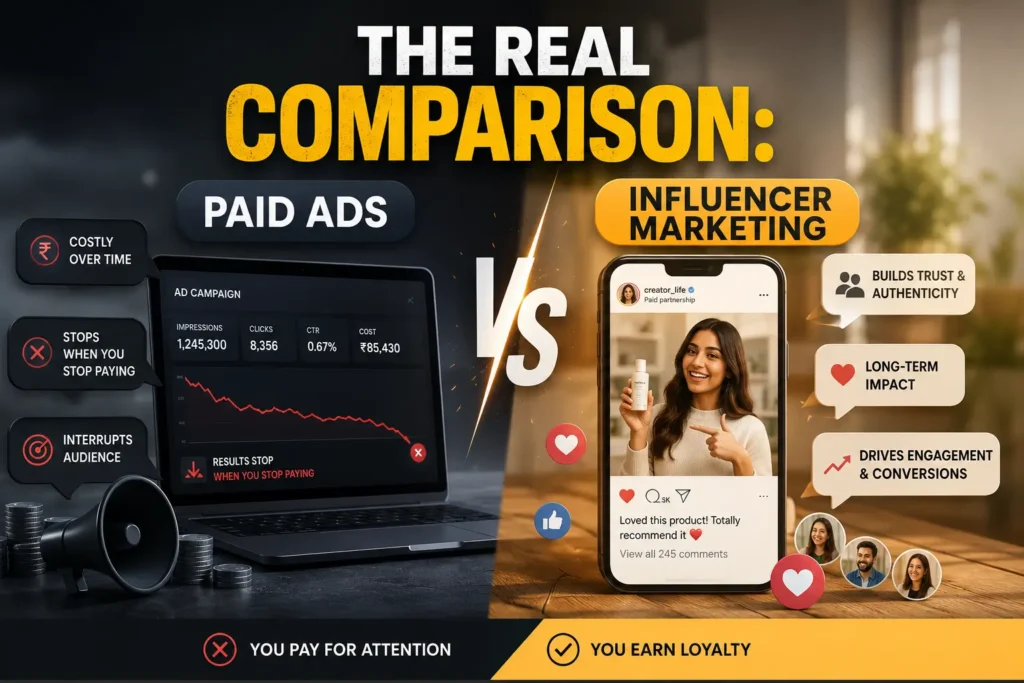
Neither channel is the full answer on its own. Paid ads are still useful, especially for retargeting people who are already close to a decision. But as a primary driver of awareness and new customer acquisition, the economics have shifted in a way that most marketing teams have not fully accounted for yet.
The brands that are figuring this out are not choosing one over the other. They are using influencer content to do the awareness and trust work, and then using paid media to amplify the creator content that is already performing. This works because creator content used as paid ad creative consistently outperforms brand-produced creative on the same platforms. So influencer investment does not just replace some of your paid spend. It makes the paid spend and you keep doing work better.
If you want to see how different industries are making this shift, this piece on why every industry is betting on influencer marketing is worth reading through.
What Reducing CAC Actually Looks Like in Practice
The brands we work with at 6th Street Artist that have seen the biggest improvement in customer acquisition cost are not the ones that ran one influencer campaign and moved on. They are the ones who committed to showing up through creators consistently over time.
Here is what that looks like in practice. A brand starts working with five to eight creators in their category. Not mega influencers. Mid-tier and micro creators whose audiences are genuinely the right fit. Over three to four months, those creators produce content that builds awareness and trust with their communities. Branded search volume for the brand starts going up. Direct traffic increases. The people coming to the website through creator referral links convert at a higher rate than people coming from cold paid ads.
By month six, the paid media budget is doing less of the heavy lifting because organic awareness is doing more of it. CAC comes down not because the brand stopped spending on paid but because influencer marketing added a channel that was building trust and awareness for free while the paid campaigns kept running.
How to Start Making This Shift
You do not have to gut your paid budget to test this. What most brands should do is take a portion of what is currently going to paid acquisition and allocate it to creator partnerships. Track CAC honestly from both channels. Let the data tell you where to put more over the next quarter.
When picking creators to work with, start with fit over size. The creator whose audience is genuinely your customer will drive more qualified traffic than a larger creator whose followers happen to include some people in your demographic. Specificity matters more than scale when the goal is reducing acquisition cost.
And once the creator content exists, use it everywhere. Run it as a paid ad creative. Put it on product pages. Include it in email sequences. The trust it earned through the creator’s channel transfers into those other contexts and makes everything perform better.
We Help Brands Make This Work
At 6th Street Artist, this is the conversation we have with brands every week. Rising ad costs, flattening returns on paid, and a real need to find a channel that builds something more durable than a click. We help brands figure out the right creator mix, build the strategy around it, and measure what actually matters so the investment makes sense on paper.
If your paid ad costs are climbing and you want to talk through what a smarter approach looks like, come talk to us.
Call us: +91 91366 69815 Email: info@6thstreetartist.com
Follow us for more: Instagram | LinkedIn | YouTube

Manpreet Singh Chadha was a visionary entrepreneur and co-founder of 6th Street Artist, a Mumbai-based influencer marketing agency. With a passion for empowering creators and brands, he played a pivotal role in shaping the agency’s mission to revolutionize influencer marketing in India. His legacy continues to inspire the industry.