
The Influencer Campaign Checklist Every Brand Should Follow
Most influencer campaigns that underperform were not unlucky. They were not well prepared.
There is an influencer marketing strategy that many companies have tried out. You identify an influencer you like, settle on the fees, send him/her the brief, the content gets published, and then the following two weeks are spent trying to see whether there was any impact. The numbers are fine, but the problem is that you don’t know what they mean. No one knows how to proceed.
The above scenario always occurs when some critical steps are ignored from the start. Influencer marketing campaign planning, if done in the correct manner, is not difficult. What it takes is doing all the right things in the right sequence. The following checklist will help brands to cover everything necessary in their influencer campaigns.
Before the Campaign: Getting the Foundation Right
This is where most campaigns are won or lost. Not on shoot day. Not in the edit. In the decisions made before any creator is even approached.
Define What Success Actually Looks Like
The first step on any influencer marketing campaign list is the one that most brands tend to ignore. What is this campaign supposed to accomplish? Not just something general like “raise awareness” or “increase engagement.” Something concrete.
Do you want more people visiting a particular product page? Getting a set number of signups? Increase your branded searches? Raise your own follower count by X amount? These all involve different kinds of campaign structures, different creators to choose from, and different things to measure when the campaign ends.
If you can’t figure out what it should accomplish before you even begin, how will you know whether it accomplished anything at the end?
Know Your Audience Before You Pick a Creator
This sounds obvious, but brands get it wrong constantly. They pick a creator they personally like or one that a competitor used recently rather than one whose audience genuinely matches their customer.
Before you look at a single creator profile, write down who your customer actually is. Not a demographic. A real person. What do they care about? What content do they save? Who do they already follow? What problem are they trying to solve that your product addresses?
That picture is your creator brief before the creator brief. Every creator you evaluate should be measured against it.
Set a Realistic Budget and Know What It Covers
Influencer campaign planning Brands that need support with creator selection, campaign execution, and performance tracking can also work with an experienced influencer marketing agency. always involves budget, and the earlier you get clear on it, the better. Your budget needs to cover creator fees, usage rights if you plan to run the content as paid ads, production support if the brief requires specific locations or props, and agency fees if you are working with a partner to manage the campaign.
Brands that set a budget for creator fees and then discover the other costs mid-campaign end up either cutting corners or going over budget. Neither is a good outcome.
Research Creators Properly Before Reaching Out
Follower count is not a shortcut for creator research. Before you approach anyone, look at their last thirty posts. What is the actual engagement like? Are the comments specific and genuine or generic? What brands have they worked with recently and does that create any conflicts? What does their audience look like in terms of demographics?
A creator with 80,000 followers and a 6% engagement rate from a genuinely relevant niche audience is worth significantly more than one with 300,000 followers and 0.8% engagement from a broad, disengaged following. The numbers on the surface tell you almost nothing. The numbers underneath tell you everything.
Choose the Right Type of Influencer for Your Campaign
Not every influencer campaign needs a celebrity or a creator with millions of followers. Choosing the right influencer type depends on your campaign objective, target audience, budget, and the level of engagement you want to achieve.
Nano influencers have smaller, highly connected communities and can be effective for local campaigns, niche products, and authentic recommendations.
Micro influencers usually have focused audiences and strong engagement within specific niches. They can be a practical choice for brands looking to balance reach, credibility, and budget.
Mid-tier influencers offer a larger audience while often maintaining strong niche relevance and engagement. They can work well for brands looking to scale their campaigns without moving directly to celebrity-level creators.
Macro influencers provide broader reach and can help brands increase awareness quickly. They are useful when the goal is to expose a product or campaign to a larger audience.
Celebrity influencers offer significant visibility and mass-market awareness. They can be valuable for major product launches, large-scale brand awareness campaigns, and products targeting a broad consumer audience.
The best choice is not always the influencer with the largest following. A successful influencer campaign checklist should consider audience relevance, engagement quality, content style, credibility, and campaign goals before follower count.
Write a Brief That Gives Creators Room to Be Themselves
The brief is one of the most important parts of influencer campaign planning, and most brands write it wrong. They over-specify. They include exact scripts, mandatory phrases, required camera angles, and so many approval checkpoints that the creator has no room to make the content sound like their own.
The best-performing creator content sounds like the creator. Not like the brand’s marketing team. A good brief gives the creator the key message, the product details they need, any mandatory disclosures, and a clear sense of the tone. Then it gets out of the way.
Creators know their audience better than you do. Trusting them with the execution is not a risk. That is the whole point.
A strong creator brief is only one part of successful content execution. Brands that need support with content strategy and SEO-optimized content can also benefit from professional content marketing services.
During the Campaign: Staying on Top of What Matters
Track the Right Signals in Real Time
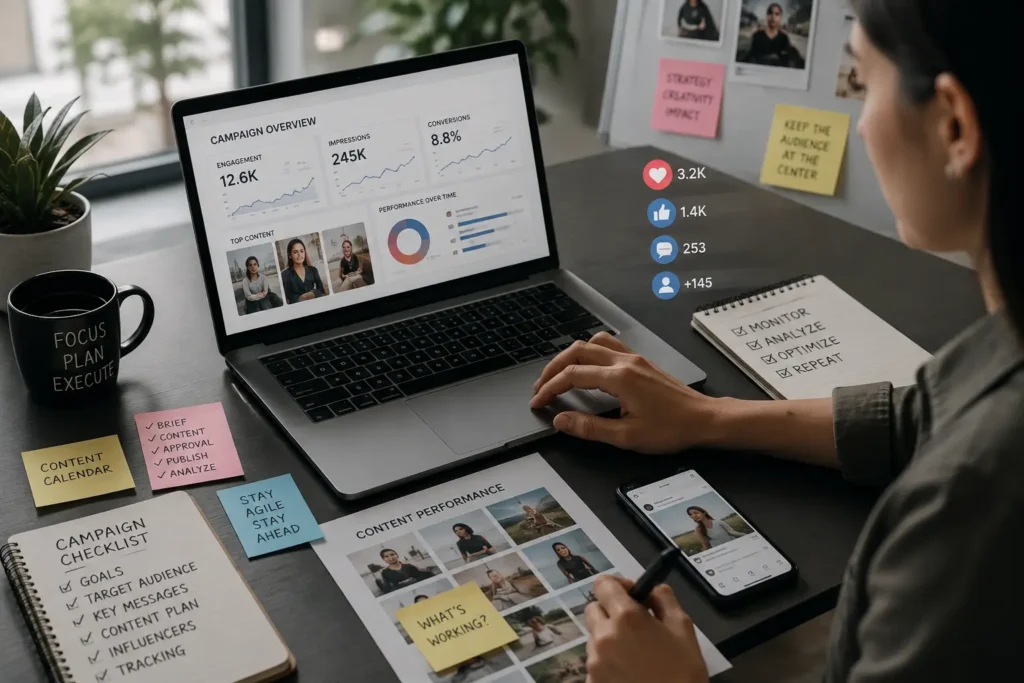
Once content goes live, the temptation is to immediately check how many likes it is getting. Resist that. The metrics worth watching in the first 24 to 48 hours are comment quality, save rate, shares, and any spikes in traffic to your website or product page.
A post with 500 genuine comments from people sharing personal experiences and asking questions is a significantly better result than a post with 5,000 likes and nothing else. Engagement quality tells you whether the content is connected. Volume tells you how many people scrolled past it.
Watch for Organic Amplification
Some of the best signals that an influencer campaign is working happen off the creator’s post. People sharing the content of their stories. Screenshots appearing in group chats. Your brand gets tagged by people who saw the creator’s content and went to your page. Searches for your brand name going up.
These organic amplification signals are easy to miss if you are only looking at platform analytics. Set up Google Alerts for your brand name during active campaigns. Check your branded search volume in Google Search Console. Watch your direct traffic. These numbers often tell a more complete story than the in-platform metrics alone.
Communicate With Creators During the Campaign
This is something brands often forget once the content goes live. Staying in touch with the creator during the campaign period matters. If a post is performing well, tell them. Ask them what their audience is saying in the DMs. Find out whether people are asking specific questions about the product that might inform the next piece of content or the next campaign.
Creators have visibility into their audience’s reactions that brand analytics simply cannot capture. That information is valuable and most brands never ask for it.
After the Campaign: Making Sense of What Happened
Measure Against the Baseline You Set Before
Remember the success metrics you defined before the campaign started? Now is when you look at them honestly. Did traffic to the product page increase? Did branded search volume lift? Did you hit the lead targets? Did follower growth move during the campaign period?
Compare every metric to the baseline you documented before launch. Without that baseline comparison, you are just looking at numbers with no context for whether they mean anything.
Look at the Thirty-Day Window, Not Just the First Week
Creator content has a longer tail than most brands account for. A well-performing reel keeps getting recommended by the algorithm weeks after it was posted. A save gets revisited. A share keeps circulating in private chats.
Check your referral traffic and branded search thirty days after the campaign ended, not just in the week following. The numbers often look better at thirty days than they did at seven because the content keeps working after the initial burst.
Decide What to Do With the Content
If creator content performed well, use it. Run it as paid advertising creative on Meta or Google. Put it on your product pages. Include it in email campaigns. Creator content that has already earned trust from an organic audience brings that trust signal into whatever paid environment you put it in.
This is one of the most underused parts of influencer campaign planning. Brands invest in creator content, use it once, and then let it sit. The brands getting the most out of their influencer budgets are the ones repurposing high-performing content across multiple channels.
Build on the Relationship, Not Just the Result
If a creator delivered strong results, the relationship is worth continuing. A creator who has already spoken about your brand positively has laid groundwork with their audience. The second collaboration builds on that foundation. The third builds on the second. The trust compounds in a way that a series of one-off partnerships with different creators never can.
The brands that consistently outperform in influencer marketing treat it as a channel they show up in repeatedly, not a tactic they try once and evaluate in isolation.
For brands looking to build long-term creator partnerships, professional talent management services can help streamline collaborations, negotiations, and ongoing brand relationships.
The Campaign Planning Mistakes This Checklist Helps You Avoid
Skipping the objective-setting step and ending up with a campaign that generated views but no clear outcome. Choosing creators based on aesthetics rather than audience fit. Writing briefs so prescriptive that the content sounds nothing like the creator. Measuring only likes and reach. Treating each campaign as standalone rather than building on what came before.
Every one of these mistakes is avoidable. They are also incredibly common. Going through this checklist properly before every campaign is the difference between influencer marketing that compounds over time and influencer marketing that produces inconsistent results and eventually gets written off.
For a deeper look at how brands across industries are building smarter influencer strategies, this piece on why every industry is betting on influencer marketing covers the bigger picture well.

Manpreet Singh Chadha was a visionary entrepreneur and co-founder of 6th Street Artist, a Mumbai-based influencer marketing agency. With a passion for empowering creators and brands, he played a pivotal role in shaping the agency’s mission to revolutionize influencer marketing in India. His legacy continues to inspire the industry.